Directional Drilling Services
HOOVER DAM PROJECT
Hoover Dam Visitor's Center - The need to drill a straight angle hole
It is doubtful that even the most optimistic early proponents of Hoover Dam could have foreseen the impact of this 726-foot (221.3 meters) high concrete arch-gravity dam. One of America's engineering wonders, it was without precedent the greatest dam of its day. It is still a world-renowned structure, with more than one million tourists visiting the dam annually. This stream of humanity generates major traffic problems as well as concern for the safety of pedestrians moving along Highway 93, the dam's two-lane road that leads to the visitor center. With ever-increasing tourism, it was decided that a new visitor center be built, located and constructed to provide awe-inspiring views of the dam, Lake Mead and Black Canyon below the dam. The location of the new visitor center necessitated rerouting several electrical cables - a job requiring the installation of a utility conduit Hoover Dam Project - Visitor's Center

Directional Drilling Services - Hoover Dam Project
The need to drill a straight angle hole
from the top of the dam to a tunnel lined with trays of power cables deep inside the canyon's west wall. To accomplish this, a 3.5 inch (90mm) diameter pilot hole had to be drilled to intersect the switchyard control conduit tunnel located a distance of 320 feet (97.5m) away. Once drilled, the pilot hole would be backreamed to a diameter of 21 inches (533.5m) to accommodate the utility conduit. To hit the breakout target, the point where the drill bit would daylight into the tunnel, the pilot hole had to be drilled at a precise angle of 12 7' 26'' (degrees-minutes-seconds) bearing S47 11' W. To intersect the target within the allowable tolerance, plus or minus two feet (0.6m) of planned hole center, required implementation of a variety of straight-hole drilling techniques.
Directional Drilling Services - Hoover Dam Project Fundamentally, drilling a straight hole depends primarily on keeping the bottom part of the drill string relatively straight. As any driller knows, in order to advance hole depth it is necessary to put weight on the drill bit.

This down force creates a tendency for the drill string to bend at the bottom of the hole, causing it to deviate from the planned trajectory. Moreover, the degree of difficulty in maintaining a straight hole is in almost direct proportion with the angle of the hole. However, several precautionary measures can be taken to prevent or minimize hole deviation. For this project these measures included using special drilling tools, controls penetration rates, frequent borehole surveys, and employing directional drilling techniques for correcting hole alignment.
The single most proven method for drilling a straight hole is to stabilize the drill string. Before drilling could begin, special stabilized drill tools had to be designed and built. An impregnated diamond core bit was manufactured based on Christensen Directional Drilling Services - Hoover Dam Project Product's Model Green bit, commonly used to drill the type of igneous rock (andesite breccia) encountered at Hoover Dam. The core bit featured an extended outside diameter (O.D.) gauge reinforced with tungsten carbide inserts. Due to the tendency to cause sidetracking on an angle hole, no diamonds were set on the O.D. gauge. Christensen Products also designed and manufactured a stabilized HXB wireline core barrel system for this application. The system featured a slightly oversized outer tube, with milled fluted channels for enhanced fluid circulation and cuttings removal. Both the core bit and wireline coring system were run using controlled drilling parameters, that is, increased rod rotation speed with reduced weight on the bit. A Surface Reading Gyroscope (SRG) was selected to survey the pilot hole, primarily for the SRG system's ability to provide real-time orientation data of hole angle and bearing and and because it is unaffected by naturally occurring or induced magnetic interference. This is especially significant when drilling through concrete embedded with steel reinforcement.
The Accu-dril® directional drilling motor is powered by circulating drilling fluid to provide rotation and torque to the bit without rotating the drill string. Simply, the motor operates on the reverse application of the Moineau progressive cavity pump principle. Directional drilling with a downhole motor requires a deflection device to change hole direction. A tool joint (bent housing) machined to a specific bend angle measured as degrees curvature par 100 feet (30.5m), is positioned uphole from the drill bit. Downhole orientation is achieved with a wireline survey instrument and an orientation collar aligned in the direction the motor will drill. As the motor advances the hole, the alignment angle increases or decreases along a continuous smooth arc, the radius of which is predetermined by the angle of the bent housing.

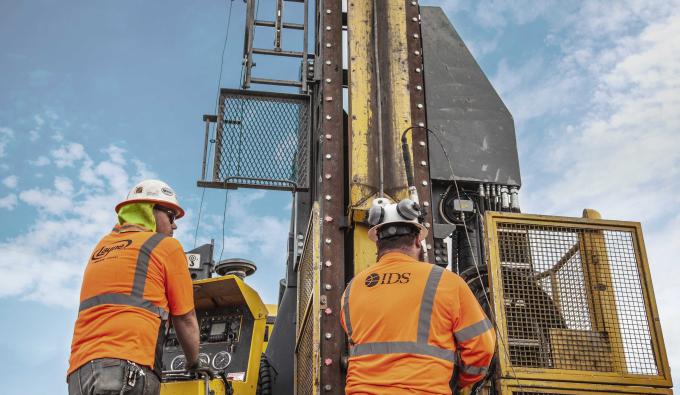
Drilling was conducted using a truck-mounted angle core drill with its mast centered over the borehole collar and aligned with the pre-set surface casing. The 7-foot (2.1m) long by 21-inch (533.5mm) diameter steel casing was collared into the rock and cemented at the prescribed angle of the pilot hole. The drilling plan called for the pilot hole to be within 2.5 inches (63.5mm) of planned hole trajectory at a point 53 feet (16.2m) from the surface. This close alignment tolerance was necessary for a proposed future drill collar. Statistically, the higher the number of surveys recorded, the greater the degree of confidence in the accuracy of the hole orientation data. For this reason, surveys were recorded every 10 feet (3m) of drilled depth. As drilling advanced the hole, overlapping survey stations provided a quality control check of the data for the preceding survey. Drill-survey-drill procedures and actual-to-proposed alignment comparisons were practiced throughout the entire project. At a vertical depth of 232 feet (70.7m), the hole was required to be within plus or minus 2 feet (6m) of planned hole alignment. Prior to reaching this drill depth, the frequency of surveys was increased to ensure the accuracy of the orientation data. At a vertical depth of 235 feet (71.6m), a survey was recorded, computed, and projected to total depth. The projection indicated that the hole, continuing its present course, would be at the maximum allowable deviation tolerance. Based on this, a decision was made to realign the pilot hole, dropping hole angle while maintaining hole bearing. A downhole motor would be used to realign the pilot hole from 230 feet (70.1m) to 260 feet (79.25m) dropping the hole angle from 12.45 to 10.5 degrees. After reestablishing hole alignment with the planned trajectory, the directional motor was pulled and core drilling resumed.

At a depth of 314.5 feet (95.85m), indications of cement cuttings in the drilling fluid provided the first evidence that the bit was in the proximity of the tunnel. Continued drilling produced interspersed rock and cement cores, and finally solid cement at the 316-foot (96.3m) level. Sounds of the approaching drill bit were heard inside the tunnel near the planned breakout point. To confirm the location of the borehole relative to the inside of the tunnel, the drill string was pulled back and a sensor lowered to the bottom of the hole where its position was marked inside the tunnel. A final gyroscopic survey was recorded, and its bottom hole coordinate marked inside the tunnel wall. From these two reference points an air-driven jack hammer was used to drill a series of small diameter exploratory holes on 3.5 inch (90mm) centers into the tunnel wall. attempting to intersect the drill hole. The bottom of the pilot hole was located when drilling fluids gushed into the tunnel, less than 18 inches (457mm) let of target center, well within the specified alignment tolerances.

Building the new center required routing electrical cables to an existing conduit tunnel deepm within the canyon wall.

The challenge was to drill a borehole at a precise angle of 12o 7' 26'' bearing S47o 11'W to hit a 24 inches diameter breakout target 320 feet distant.
International Directional Services

12030 East Riggs Road
Chandler, Arizona 85249
Tel: 480.824.7100
Fax: 480.883.2010
E-mail: idsinfo@idirectionaldrill.com

IDS HOME | HISTORY | EQUIPMENT | COST EFFECTIVE | APPLICATIONS
PRODUCT SALES | PRODUCT RENTALS | SERVICES | PROJECTS | CONTACT US

© 2008 Layne Christensen Company. All rights reserved.